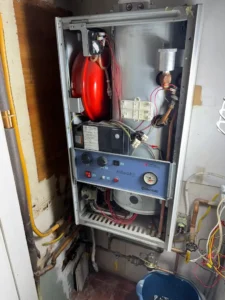
Most people never look at the pressure gauge on their boiler until something goes wrong. Then the needle is sitting lower than it used to, the heat is not quite right, and a quick search suggests topping the system back up. That works, for a while. A few weeks later the needle is low again.
A boiler that keeps losing pressure is telling you something specific: water is leaving a system designed not to lose any. Here is what the gauge measures, the usual reasons the reading falls, and the point at which refilling stops being sensible.
What Does Boiler Pressure Actually Mean?
A hot water boiler system is a closed loop. The same water circulates from the boiler, out through the piping to your radiators or baseboard, and back again. Under normal conditions that water never leaves the loop and never needs replacing. The pressure gauge measures how hard that water is pressing against the inside of the system.
Two things set that pressure. The water itself, filled to a static pressure when the system was commissioned, and heat: water expands as it warms, so the reading rises during a heating cycle and settles back as the system cools. A gauge that moves between a cold number and a hot number is behaving normally. A gauge that keeps drifting down over weeks is not.
There is no single correct number, and this matters more than most homeowners realize. For a typical North American residential hot water system, a cold reading around 12 psi is common, with the hot reading climbing to roughly 20 psi during operation. But the correct cold pressure depends on the building. Water has to be pushed up to the highest radiator in the house, so a three-story home generally needs a higher starting pressure than a two-story one.
The safety side varies too. Weil-McLain’s installation manual for one common residential gas boiler line refers to models fitted with a 30 psig relief valve and other models in the same line fitted with a 50 psig valve. Two boilers from the same manufacturer, two different thresholds. Anyone who tells you there is one universal correct pressure for all boilers is guessing.
Steam boilers are a different animal. Residential steam systems run at a small fraction of hot water pressure, often a few tenths of a psi, and are filled and controlled differently. If your system makes steam rather than circulating hot water, much of what follows applies differently.
Why Does Boiler Pressure Keep Dropping?
In a sealed loop, falling pressure means water has gone somewhere. The question is where.
A leak you can see. The obvious one. Water around the base of the boiler, a damp patch under a pipe joint, a stain on a ceiling below a radiator, corrosion marks on a fitting. A drip small enough to evaporate before it pools can still drop your pressure noticeably over a month.
A leak you cannot see. Hydronic piping often runs under floors, inside walls or through crawl spaces, and a slow weep in a buried section can go unnoticed for a long time while the gauge quietly falls. There is nothing to spot by walking around the basement, so these need a technician to track down.
Water leaving through the relief valve. The pressure relief valve is a safety device that opens if system pressure climbs past its rating. Every time it discharges, water leaves the system. A valve can also fail to reseat properly: mineral deposits, corrosion or debris on the seat will stop it sealing, and it will weep continuously afterwards. Either way, water that goes out of the discharge pipe is water the loop no longer has.
An expansion tank problem. The expansion tank gives heated water somewhere to go as it expands. It holds a cushion of air, usually separated from the water by a diaphragm. When that air charge is lost or the diaphragm fails, the tank fills with water and stops absorbing expansion. A lot of advice gets this backwards: a failed expansion tank usually shows up as pressure climbing too high during a heating cycle, not as a slow drop. The connection to pressure loss is indirect. If pressure spikes far enough that the relief valve discharges, water leaves the system, and you end up refilling it. The tank is the root cause; the relief valve is the exit.
Air being removed from the system. This one is often harmless. If radiators have recently been bled, or a technician purged air during a service, water has been let out along with the air. The gauge reads lower afterwards because there is genuinely less water in the loop. That is a one-time adjustment, not a fault. It is only a problem if the reading keeps falling after that.
Something else. Not every boiler has the same components or the same failure modes, and a pressure symptom can trace back to a part that is not on this list. The point of knowing the causes is not to pick one yourself, but to describe what you have seen.
Why Does the Pressure Drop Again After You Refill It?
Because refilling fixes nothing. It replaces the water that escaped without addressing why. If the pressure is back down a month later, the leak never stopped; you just topped up ahead of it.
That is worth more than an inconvenience, because repeated refilling does real damage. Weil-McLain states it plainly in its boiler manual: “Continual fresh makeup water will reduce boiler life.” The reason is what comes in with the water. Fresh water carries dissolved oxygen, and the same manual warns that the “addition of oxygen and other gases can cause internal corrosion.” It also carries minerals, and mineral buildup inside the boiler “reduces heat transfer, overheats cast iron, and causes section failure.”
So the habit that feels like taking care of the system is quietly shortening its life. The same manual’s instruction on leaks is blunt: repair them at once, specifically to prevent makeup water entering the system.
Some systems have an automatic feed valve that tops up the pressure without anyone touching anything. That is more convenient and more dangerous: a leak can run for months with no visible symptom while the valve keeps feeding fresh, oxygenated water into the loop.
Can Low Boiler Pressure Stop the Heat From Working?
It can, and whether it does depends on your system.
Many modern boilers have a low-pressure cut-off that locks the unit out rather than letting it fire with insufficient water. If yours does, low pressure will stop the heat outright and often shows a fault code. Other systems will keep running but heat badly: if there is not enough pressure to push water to the top of the house, upstairs rooms go cold while the ground floor is fine. Low pressure can also contribute to noise, which is one reason a boiler that has started making banging, kettling or whistling sounds is worth looking at rather than ignoring.
What Can a Homeowner Safely Check?
Observation is the useful part. A technician arriving with a clear history diagnoses faster than one starting from scratch.
Read the gauge and write the number down with the date. Read it again cold and again after the system has run, so you know how much it moves in a cycle. Look around the boiler and along exposed piping for water, damp patches, staining or corrosion, and check whether anything is dripping from the relief valve discharge pipe. Note whether the pressure falls steadily or drops suddenly after a heating cycle. Check the user manual for your specific boiler, which gives the range intended for that unit.
What not to do matters just as much. Do not cap, plug or obstruct the relief valve or its discharge pipe, and do not fit a higher-rated valve to stop it discharging. That valve stands between a pressure fault and a dangerous one. Leave gas components, combustion parts, safety controls and the sealed pressure side to a licensed technician.
When Should You Call for Boiler Repair?
Call when the pressure drops more than once. A single low reading after a service or radiator bleed is explainable. A reading that keeps falling means water is leaving, and the only question is where from.
Call sooner if you can see water near the boiler, if the relief valve is discharging, if the boiler is locking out on pressure, or if rooms have gone cold. Several of these also appear among the broader signs a boiler needs repair, and pressure loss rarely travels alone.
M&S Technician has handled boiler repair and installation across North Jersey since 2013. We offer free estimates, same-day service when the schedule allows, and 24/7 emergency availability when heat fails outside business hours. Annual heating system maintenance is also the cheapest time to catch a slow leak, because the pressure check is part of the visit rather than an emergency call in February.
Boiler Pressure Problems in North Jersey
Much of the housing stock around Woodland Park, Clifton, Little Falls and the surrounding Passaic and Bergen County towns is on its second or third boiler, with original piping still behind it. Older hydronic piping and its fittings are where slow leaks tend to start, and a cold snap after a mild stretch is when a weeping joint that had been coping finally shows up on the gauge.
If your boiler keeps losing pressure, the useful next step is finding out where the water is going rather than replacing it again. Call M&S Technician at (908) 528-0535 and we will come and look at it.