When it’s time to replace your water heater, the first decision is the big one: stick with a traditional tank or switch to tankless? The honest answer is that neither type is universally better. The right choice depends on your house, your hot-water habits, and your budget.
Here’s a straight comparison.
How Each Type Works
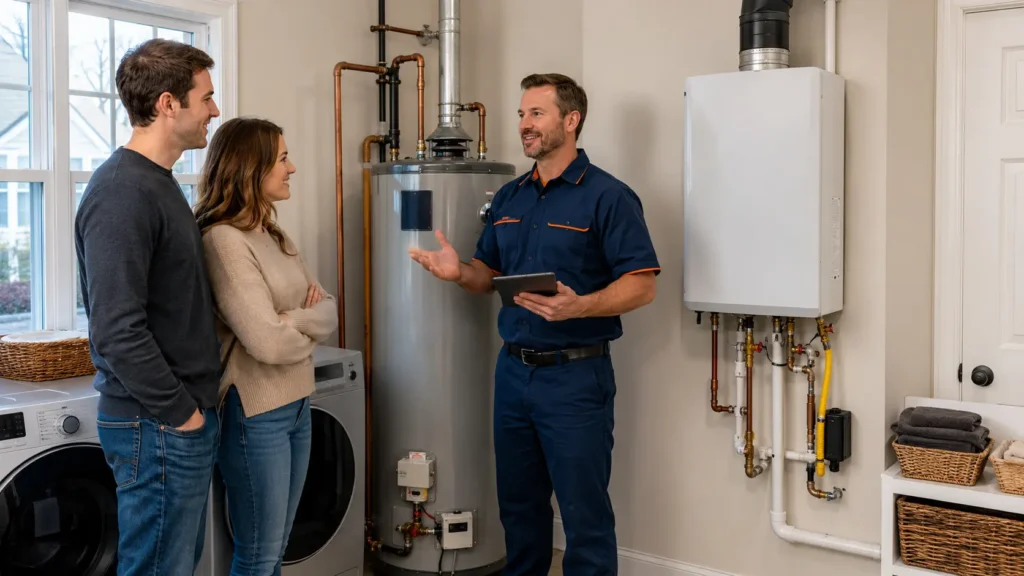
Tank water heaters. A big insulated cylinder (typically 40 to 80 gallons) holds heated water. The unit constantly maintains the water at a set temperature, ready for use. When you turn on the hot tap, water from the top of the tank flows out, and cold water fills in at the bottom to be heated.
Tankless water heaters. No tank, water is heated on demand as it flows through a heat exchanger. Turn on the hot tap, the unit fires up, and you get continuous hot water for as long as you need it. When you shut off the tap, the unit shuts down.
Side-by-Side Comparison
- Upfront unit cost: Tank ~$500–$1,500 / Tankless ~$1,500–$3,500
- Installation cost: Tank ~$500–$1,500 / Tankless ~$1,500–$4,000+
- Lifespan: Tank 8–12 years / Tankless 20+ years
- Annual energy use: Tank higher (always heating) / Tankless lower (heat on demand)
- Recovery time: Tank limited by tank size / Tankless unlimited
- Footprint: Tank 4–6 sq ft floor / Tankless wall-mounted, ~6 sq ft wall
- NJ rebates: Tank limited / Tankless higher rebates available
- Annual maintenance: Tank flushing / Tankless flushing + descaling
The numbers above are typical ranges in our area. Your specific quote depends on the unit, the install complexity, and what code upgrades are needed.
Tankless Is the Better Choice If...
You have a big family or heavy hot-water demand. Multiple back-to-back showers, big dishwasher loads, laundry running while someone showers, tankless never runs out. A 40-gallon tank can.
You take long showers. A tank holds a fixed amount of hot water. When it’s gone, you wait for it to recover. Tankless gives you hot water as long as you keep the tap running.
You want lower energy bills. Tank heaters lose heat constantly through the tank walls (called “standby loss”). Tankless units don’t. The Department of Energy estimates tankless can be 24–34% more energy efficient for typical homes.
You want longer-lasting equipment. Tankless units routinely last 20+ years with maintenance. Tank heaters average 10. If you plan to stay in your home, the lifespan math favors tankless.
You’re tight on space. Tankless units are wall-mounted, freeing up the floor space a tank takes up.
You qualify for higher rebates. The NJ Clean Energy Program offers larger rebates on high-efficiency tankless units than on standard tanks.
Tank Is the Better Choice If...
You have low to moderate hot water use. A 1- or 2-person household using normal amounts of hot water won’t notice a meaningful difference between tank and tankless in daily use. The tank works fine.
You’re on a tight upfront budget. A standard tank install is significantly cheaper than tankless. If you can’t swing the higher upfront, a tank is a real option.
Your home isn’t easy to convert. Tankless units need higher gas flow (which sometimes means a new gas line), specific venting, and adequate electrical for the controls. If your home isn’t set up for it, the conversion cost can balloon.
You want simpler maintenance. Tank heaters need annual flushing. Tankless units need flushing AND descaling. Both are doable, but tank is simpler.
You’re planning to move soon. The energy savings on tankless take years to pay back the higher upfront cost. If you’re moving in 3 years, that math doesn’t work as well.
What Changes for Older Woodland Park Homes
A lot of homes around here were built between 1940 and 1970. That can complicate a tankless conversion in three ways.
Gas line size. Tankless units need a larger gas line than most tanks. If your existing gas line is 1/2 inch, it may need to be upgraded to 3/4 inch (or larger). That’s a few hundred to a few thousand dollars depending on the run.
Venting. Tankless units use direct-vent systems that go through an exterior wall, not a chimney. Some older homes need significant venting work to make this work cleanly.
Electrical panel. Tankless units have electronic controls that need a dedicated 120V circuit. Most homes have this already, but older panels can be a constraint.
A good installer (and the estimate process) catches all of this before you sign anything. We do a full home assessment as part of every install quote.
NJ Clean Energy Program Rebates
As of this season, the NJ Clean Energy Program offers rebates on qualifying high-efficiency water heaters. Amounts shift, but typical ranges:
- High-efficiency gas tankless: $500–$1,200
- Heat-pump water heater: $300–$700
- Standard high-efficiency tank: more limited rebates
Federal tax credits also apply to qualifying heat pump and high-efficiency units. We handle the rebate paperwork as part of the installation.
How M&S Technician Helps You Choose
When we come out for an estimate, we look at:
- Household size and hot-water habits
- Your existing gas line, venting, and electrical
- Whether your space supports either type
- What rebates and financing apply to each option
- How long you plan to stay in the home
Then we give you written quotes for both options if both are viable. No high-pressure pitch toward whichever type has higher margin. The right answer depends on your situation, and that’s how we approach it.
A Real Woodland Park Scenario
Here’s how this plays out for an actual household.
Consider a family of four—two parents and two teenagers—living with one bathroom upstairs and a half-bath on the main floor. They currently have a 50-gallon gas tank water heater installed in 2014. The unit is 12 years old, starting to make rumbling sounds, and its recovery time has gotten noticeably slower over the last two winters.
Faced with these warning signs, the family is comparing two options. A standard tank replacement quote comes in at $1,800 for a new 50-gallon high-efficiency gas tank, fully installed. Meanwhile, a tankless conversion quote is priced at $4,500 for a high-efficiency gas tankless system, installed (which includes the necessary gas-line upsize and new direct venting).
While initial sticker shock heavily favors the traditional tank, the mathematical and practical advantages of a modern tankless water heater installation become much more interesting once you factor in long-term performance, energy efficiency, and overall household comfort. For a deeper look into how these systems compare over time, you can explore the U.S. Department of Energy tankless water heater guide.
Whether you decide to stick with a reliable traditional setup or make the jump to endless hot water, our team at M&S Technician is here to help. We can walk you through the details of a water heater replacement in Woodland Park to find the perfect fit for your family’s daily routine, all backed by the expertise of our water heater services.
- Tankless lasts 20+ years vs. 10 for a tank, over 20 years, the tankless avoids one full replacement cycle
- Energy savings of around 25%, for this family, roughly $200-$300 per year on gas
- NJ Clean Energy Program rebate of $800 on the tankless
- Federal tax credit potentially applicable
Net cost difference shrinks from $2,700 to under $1,200 over the first few years, and the tankless saves money every year after.
For this family, the tankless made sense, multiple back-to-back showers in the morning was a daily issue, and the 20-year horizon worked for them.
For a one- or two-person household with low hot-water demand, the same math doesn’t work as cleanly. The energy savings are smaller, and the upfront delta takes much longer to pay back. A standard high-efficiency tank is often the right call.
What Most Contractors Won't Tell You
Some honest things about this comparison that don’t usually make it into sales pitches.
Tankless isn’t right for every home. If your gas line is undersized and the cost to upgrade it is $1,500, you’re spending $6,000 on a tankless install that should have cost $4,500. Sometimes the home isn’t ready for it.
The energy savings vary. The 24-34% savings number from the Department of Energy is an average. Real-world savings depend on your usage patterns, your insulation, and how high you keep your tank temperature.
Tankless requires more maintenance. Annual descaling is part of the deal. If you don’t keep up with it, the heat exchanger scales up, efficiency drops, and the unit can fail prematurely. Tank flushing is simpler.
Tank-to-tankless conversion isn’t always clean. If your old tank was vented through the chimney, the new tankless will need a direct vent through an exterior wall. That can mean drilling and patching where you don’t want it.
We tell our customers all of this during the estimate. The right answer depends on your house, not on what we’d rather sell you.
Frequently Asked Questions
Do you offer same-day water heater service in Woodland Park?
Yes. We schedule same-day repairs Monday through Saturday when our route allows. New installations typically take a week or so to schedule. Call (908) 528-0535.
Do you serve all Woodland Park neighborhoods?
Yes. We’re based in Woodland Park and cover every neighborhood, plus surrounding towns including Little Falls, Totowa, Clifton, and Wayne.
Do you work on tankless and traditional tank water heaters?
Yes. We install and service both tank and tankless units. We can also walk you through which type makes sense for your specific home during a free in-home estimate.
Do you offer financing on water heater replacement?
Yes. We offer financing on new water heater installations to help break up the cost, especially useful for tankless installs, which are more expensive upfront. Ask about current plans when you call.
Are you licensed and insured in New Jersey?
Yes. M&S Technician holds NJ HVAC License #368100867400 and carries full liability insurance. We’ve been a licensed contractor in North Jersey since 2014.
Ready to Replace Your Water Heater?
Call M&S Technician at (908) 528-0535 to schedule a free in-home water heater estimate in Woodland Park. We’ll assess your home, walk through both tank and tankless options, and give you written quotes for what fits.
M&S Technician. Licensed HVAC contractor in Woodland Park, NJ. Same-day water heater service across Passaic County.
Phone: (908) 528-0535 (click-to-call on mobile) Address: 4 Winslow Place, Woodland Park, NJ 07424 Hours: Mon–Sat 9:00 AM – 8:00 PM NJ HVAC License #368100867400