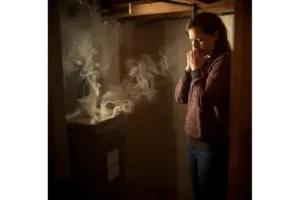
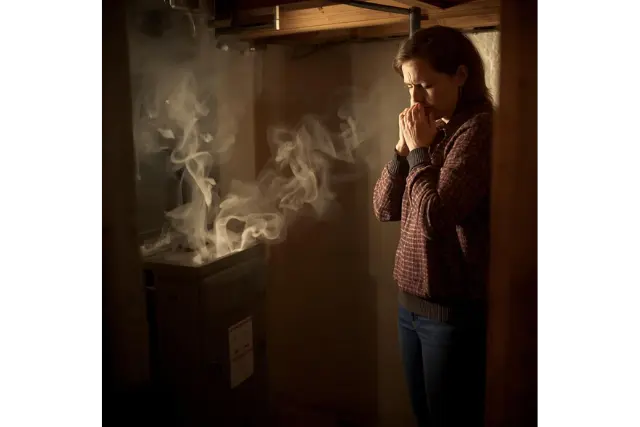
You smell it every time the furnace kicks on. That weird odor that makes you wrinkle your nose and wonder if something’s wrong. But then the smell fades after a few minutes, life gets busy, and you tell yourself you’ll deal with it later.
Here’s what homeowners in Woodland Park and Bergen County need to understand: your nose is your furnace’s early warning system. That strange furnace smell isn’t just unpleasant; it’s your heating system literally telling you something is wrong right now. Your furnace is in need of immediate care. And every day you ignore that warning, the problem gets worse, more dangerous, and exponentially more expensive to fix.
At M&S Technician, we’ve seen it all. The homeowner who ignored a burning smell for three weeks until their furnace caught fire. The family who dismissed a musty odor as “just dust” until they discovered thousands of dollars in mold damage throughout their ductwork. The couple who overlooked a gas smell because “it goes away quickly” until carbon monoxide sent them to the emergency room.
These aren’t scare tactics. These are real situations we’ve responded to, and in every single case, the homeowner told us the same thing: “I noticed the smell weeks ago, but I didn’t think it was serious.”
Today, we’re breaking down exactly what different furnace smells mean, what’s causing them, and more importantly, what it costs when you wait too long to address them. Consider this your permission to stop procrastinating and start protecting your home, your family, and your bank account.
The Burning Dust Smell: The Only “Normal” Furnace Odor
What it smells like: Like someone left the oven on with nothing in it, or clothes in the dryer too long. Slightly acrid, but not chemical or overwhelming.
When it happens: The first few times you turn on your furnace each fall, or after extended periods without use.
What’s actually happening: During the months your furnace sits idle, dust settles on the heat exchanger and other hot components. When you fire up the system, that accumulated dust burns off, creating the smell. This is the one furnace odor that’s actually normal and expected.
The timeline: This smell should disappear completely within 15-30 minutes of your first few heating cycles. If it persists beyond the first day of furnace operation, or if it returns later in the season, you’re not dealing with normal dust burnoff anymore.
When to worry: If the burning dust smell continues past the first few uses, gets stronger over time, or returns after initially going away, you have excess dust accumulation that indicates poor filtration or airflow issues. While not immediately dangerous, this suggests your system needs attention before it develops into a more serious problem.
The cost of addressing this early: $150-250 for professional cleaning and a new air filter. The cost of ignoring it: restricted airflow leading to overheating, which causes heat exchanger damage ranging from $1,500-3,000, or more likely, complete furnace replacement at $3,500-6,000.
The Burning Plastic or Rubber Smell: Electrical Problems in Progress
What it smells like: Distinct chemical odor, like burning plastic bags or rubber bands. Sharp, acrid, and unmistakable once you’ve smelled it.
What’s actually happening: Something in your furnace is overheating, and it’s almost always electrical. This could be wire insulation melting due to a short circuit, a failing blower motor overheating its housing, a capacitor beginning to fail, or electrical components making poor contact and creating heat buildup.
Modern furnaces use plastic and rubber components for wire insulation, motor mounts, and various seals. These materials have specific heat tolerances. When they start to smell, they’re already being damaged by excessive heat.
The danger you’re facing: Electrical fires don’t announce themselves with flames and smoke. They start exactly like this, with components overheating gradually until they reach ignition temperature. Your furnace operates in a confined space, often near combustible materials like cardboard boxes, stored items, or even the wood framing of your home.
The timeline of damage: Electrical problems accelerate rapidly. That burning plastic smell today becomes a complete motor failure tomorrow and an electrical fire next week. Each time your furnace runs, the overheating component gets hotter, the damage spreads, and the fire risk increases.
We responded to a call in Morris County last January where a homeowner had been smelling burning plastic “for about a month” but kept using the furnace because it was still producing heat. By the time we arrived, the blower motor wiring had melted through its insulation and was arcing against the metal housing. The homeowner was literally one cycle away from an electrical fire that could have destroyed their home.
What it costs to fix now vs. later:
Right now, when you first smell burning plastic, the problem might be a loose wire connection ($100-150 to tighten and secure), a failing capacitor ($150-250 to replace), or a motor beginning to overheat ($300-500 for motor replacement).
After you wait and the damage spreads: complete blower assembly replacement ($800-1,200), control board replacement from electrical surge damage ($400-600), plus the original motor or wiring repair you still need, plus potential fire damage to surrounding areas (thousands to tens of thousands of dollars).
Turn off your furnace immediately if you smell burning plastic or rubber. Don’t run it “just until the repair person can come.” Every time it cycles on, you’re risking fire. Call M&S Technician at (908) 528-0535 for emergency service, and don’t restart your system until we’ve inspected and cleared it.
The Rotten Egg or Sulfur Smell: The Most Dangerous Odor
What it smells like: Rotten eggs, sulfur, or decomposing organic matter. This smell is deliberately added to natural gas to make leaks detectable.
What’s actually happening: You have a gas leak somewhere in your system. Natural gas is odorless in its pure form, but utility companies add mercaptan, a chemical that smells like rotten eggs, specifically so people can detect dangerous leaks.
Gas leaks occur from failed connections, cracked gas lines, faulty gas valves, or damaged heat exchangers. As your furnace ages and components expand and contract with temperature changes, seals can fail and cracks can develop.
The immediate danger: Natural gas is explosive in certain concentrations. It’s also heavier than air in some conditions, meaning it can accumulate in basements and enclosed spaces. You’re not just risking a furnace problem, you’re risking an explosion that could level your home.
What you must do right now: If you smell gas, this is not a “call for service tomorrow” situation. Follow this protocol immediately:
Do not touch any electrical switches, including light switches. Even the small spark from flipping a switch can ignite accumulated gas.
Do not use your phone inside your home. Take it outside before making calls.
Evacuate everyone from your home immediately. Don’t gather belongings, don’t stop to put on shoes, just get everyone outside.
Once outside and at a safe distance, call your gas company’s emergency line. They will send someone immediately to shut off your gas and locate the leak.
After the gas company has secured your home, call M&S Technician for emergency furnace repair. The gas company will shut off your gas, but they won’t repair your furnace. You need a licensed HVAC technician to identify the leak source, make repairs, and verify safe operation before gas can be restored.
The cost of addressing this immediately vs. waiting:
There is no “wait and see” with gas leaks. But let’s talk about what happens if you smell gas intermittently and convince yourself it’s not serious because it comes and goes.
That intermittent gas smell means you have a leak that’s active under certain conditions. Maybe when the furnace is running, maybe when it first starts up, maybe when wind direction changes and affects your venting. Each time that leak occurs, you’re releasing explosive gas into your home.
The repair cost for a gas leak varies depending on the source. A failed connection or seal might cost $200-400 to repair. A cracked heat exchanger requires furnace replacement at $3,500-6,000.
But here’s the real cost: we’ve responded to homes where gas leaks caused explosions. The homeowners told us later they had been smelling gas “on and off for a few weeks.” The property damage exceeded $100,000 in one case. In another, a family member was hospitalized.
Don’t become a statistic. Rotten egg smell equals immediate evacuation and emergency calls. No exceptions, no “let me just finish what I’m doing first.”
The Musty or Moldy Smell: Hidden Water Damage
What it smells like: Damp basement, old books, mildew, or gym locker room. Earthy and organic, definitely unpleasant but not as alarming as chemical or gas smells.
What’s actually happening: You have moisture somewhere in your HVAC system, and where there’s moisture, there’s mold. This could be in your ductwork, on your evaporator coil if you have central air conditioning, in your condensate pan, or even in wall cavities where ductwork has condensation issues.
Furnaces can contribute to mold growth in several ways. If your ductwork has leaks, it can draw in humid air from crawlspaces or attics. If you have both heating and cooling, your AC evaporator coil sits right in the airflow path, and any moisture that doesn’t drain properly creates ideal mold conditions.
Why you can’t just ignore it: Every time your furnace blows air through your home, it’s distributing mold spores into every room. You’re breathing these spores constantly. Your children are breathing them. Your elderly parents visiting for the holidays are breathing them.
Mold exposure causes respiratory problems, allergic reactions, asthma attacks, and in people with compromised immune systems, serious infections. Some molds produce mycotoxins that cause neurological symptoms and long-term health problems.
The timeline of mold damage: Mold doesn’t just appear overnight. By the time you smell it, you have significant growth that’s been developing for weeks or months. Mold spreads exponentially, doubling its coverage area every 24-48 hours under ideal conditions.
That musty smell you’ve been ignoring for three weeks? The mold colony causing it has grown exponentially during that time, spreading deeper into your ductwork, into your insulation, potentially into your walls.
What it costs to fix now vs. later:
Caught early, mold remediation in ductwork costs $500-1,500 depending on the extent of growth and the accessibility of your ducts. This includes cleaning, sanitizing, and addressing the moisture source that allowed mold to grow.
After you’ve ignored it for months: complete duct replacement ($3,000-6,000 for a typical home), mold remediation in wall cavities and insulation ($2,000-10,000 depending on spread), potential health issues requiring medical treatment (costs vary but can be substantial), and decreased home value if you try to sell a house with documented mold issues.
We inspected a home in Woodland Park last spring where the homeowners had been smelling “something musty” for over a year but never addressed it. When we opened their ductwork, we found mold growth covering over 60% of the interior surfaces. The remediation cost exceeded $8,000, and they needed to temporarily relocate their family during the work.
Schedule a duct inspection with M&S Technician if you smell any musty or moldy odors. We use cameras to inspect ductwork without destructive access, identify the moisture source, and provide a clear remediation plan before the problem spreads further.
The Chemical or Formaldehyde Smell: Heat Exchanger Cracks
What it smells like: Formaldehyde, strong chemical odor, or something that makes your eyes water and throat feel scratchy. Some people describe it as smelling like embalming fluid or a nail salon.
What’s actually happening: You most likely have a cracked heat exchanger. The heat exchanger is the component that separates combustion gases from the air that circulates through your home. When it cracks, combustion byproducts including formaldehyde and other chemicals leak into your breathing air.
Heat exchangers crack from age, thermal stress (repeated heating and cooling), corrosion, or operating strain from poor maintenance. Once cracking begins, it progresses quickly because the crack edges are subject to intense heat and flexing.
The carbon monoxide connection: Cracked heat exchangers don’t just leak formaldehyde. They also leak carbon monoxide, an odorless, colorless, deadly gas. That chemical smell is actually a warning sign that your furnace is also producing CO that you can’t smell.
Carbon monoxide poisoning symptoms mimic the flu: headaches, nausea, dizziness, confusion, and fatigue. Many people ignore these symptoms or attribute them to winter illnesses, never realizing they’re being poisoned in their own homes.
The cold, hard truth about cracked heat exchangers: They cannot be repaired. The heat exchanger is the heart of your furnace, and replacing just that component costs nearly as much as a new furnace installation. When your heat exchanger cracks, you need furnace replacement.
Manufacturers and HVAC professionals will not attempt to repair cracked heat exchangers because the liability is too great. Even a small crack allows deadly gases into your home, and there’s no repair method that provides reliable, long-term safety.
What it costs when you catch it early vs. late:
Here’s the thing about heat exchanger cracks: there is no “early” that saves you money on the actual repair. A cracked heat exchanger means furnace replacement, period. But catching it early saves you in other ways.
Early detection means: controlled replacement on your timeline ($3,500-6,000 for quality furnace installation), no emergency service fees, time to research rebates and financing options, ability to schedule installation at your convenience, and most importantly, no carbon monoxide exposure for your family.
Late detection means: emergency replacement in the middle of winter ($5,000-8,000 with emergency premiums), potential carbon monoxide poisoning requiring medical treatment, possible temporary relocation while you wait for installation, limited time to make informed decisions about equipment selection, and the stress of managing a crisis.
We responded to a call last February where a family had been smelling a chemical odor for over a month. They kept using the furnace because “it still heats the house.” Three family members ended up in the emergency room with carbon monoxide poisoning. The homeowner not only paid for emergency furnace replacement but also faced medical bills, time lost from work, and the trauma of nearly losing family members.
Install a carbon monoxide detector immediately if you don’t already have one, and call M&S Technician for immediate emergency repair if you smell any chemical odors from your furnace. We can test for CO, inspect your heat exchanger with cameras, and provide honest guidance about your options.
The Gunpowder or Metallic Smell: Overheating Components
What it smells like: Burnt metal, gunpowder, or a sharp metallic odor. Similar to the smell in the air after fireworks or after grinding metal.
What’s actually happening: Metal components in your furnace are overheating to the point where they’re beginning to oxidize or even melt. This typically involves your blower motor, fan belt (if you have one), or circuit boards.
The metallic smell comes from metal oxide particles being created as components overheat. You’re literally smelling your furnace destroying itself in real-time.
Why this happens: Overheating occurs when components work too hard due to restricted airflow, failing bearings creating friction, electrical problems causing resistance heating, or components simply wearing out after years of operation.
Remember our discussion about those strange sounds your furnace makes? Grinding or squealing sounds often precede this metallic smell. The sound is the mechanical problem, and the smell is the heat damage that problem creates.
The progression timeline: You might notice the metallic smell sporadically at first, maybe just at the start of heating cycles or after the furnace has run for a while. This intermittent pattern gives homeowners false confidence that it’s “not that bad.”
But overheating damage is cumulative and accelerating. Each time that component overheats, it sustains permanent damage. The damage makes it work less efficiently, which causes more strain, which creates more heat, which causes more damage. It’s a downward spiral that ends in complete failure.
What it costs to fix now vs. later:
Catching overheating early: blower motor replacement ($300-500), new capacitor ($150-250), or fan belt replacement ($100-150). These are straightforward repairs that take a few hours and restore your system to reliable operation.
After you’ve ignored the smell for weeks: complete blower assembly replacement including housing damaged by heat ($800-1,200), circuit board replacement from thermal damage ($400-600), potential heat exchanger damage from overheating ($3,500-6,000 for new furnace), and secondary damage to other components from system strain.
Turn off your furnace if you smell gunpowder or metallic odors. Running an overheating component risks catastrophic failure that could damage multiple systems. Call M&S Technician immediately for diagnosis and repair before you turn it back on.
The “It Only Smells for a Minute” Trap
Here’s the most dangerous lie homeowners tell themselves: “It only smells for a minute when the furnace first starts, so it can’t be serious.”
Wrong. Dead wrong.
Intermittent smells are often more dangerous than constant odors because they indicate problems that occur under specific conditions. A gas leak that only happens during ignition is still a gas leak. Electrical components that only overheat during startup are still creating fire risk.
Intermittent problems also accelerate faster than constant issues. A component that overheats every startup cycle is being thermally shocked, which causes rapid degradation. You might have weeks or months with a constant problem but only days with an intermittent one before complete failure.
The other problem with intermittent smells: they’re easy to dismiss and forget. You smell something, it goes away, you get busy, and you never make that service call. Meanwhile, the problem is progressing every single day.
What M&S Technician Does When You Call About Furnace Odors
When you contact M&S Technician about strange furnace smells, we don’t guess. We diagnose.
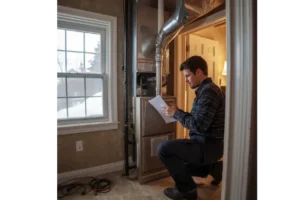
Our technicians start with a safety inspection. Before we look at anything else, we test for carbon monoxide and gas leaks. Your family’s safety is the first priority, and we clear any immediate dangers before moving to diagnosis and repair.
We use diagnostic cameras to inspect heat exchangers without disassembly. These specialized cameras allow us to see cracks and damage that would otherwise require hours of labor to access. This saves you money on diagnostic time while giving us definitive answers about heat exchanger condition.
We test all electrical components under load conditions. It’s not enough to check if something works when the system is off. We need to see how components perform under actual operating conditions, because that’s when overheating and failures occur.
We inspect ductwork for mold when musty smells are present. Our camera systems allow us to document mold growth and show you exactly what we’re seeing. No guessing, no unnecessary work, just clear evidence and solutions.
We provide honest recommendations with clear pricing. If you need furnace replacement, we’ll tell you why repair isn’t safe or cost-effective. If a simple repair solves the problem, we’ll do exactly that and nothing more. We build relationships with customers through honesty, not through unnecessary upselling.
The Hidden Costs Nobody Talks About
Beyond the direct repair or replacement costs, ignoring furnace smells carries hidden expenses that add up quickly:
Higher energy bills. A furnace with problems runs inefficiently, consuming more gas or electricity to produce the same heat. Homeowners who ignore issues for months often see 20-30% increases in heating costs without realizing their furnace is the cause.
Decreased home value. If you try to sell your home, inspectors will identify furnace problems. You’ll either need to repair them before closing or reduce your sale price to account for the buyer’s repair costs. That musty smell you’ve been ignoring could cost you thousands in negotiating power.
Health care costs. Mold exposure, carbon monoxide poisoning, and respiratory irritation from chemical odors lead to doctor visits, prescriptions, and potentially emergency room trips. One ER visit for carbon monoxide poisoning costs more than a new furnace.
Emergency hotel costs. When your furnace fails completely in the middle of winter, you might need temporary housing while waiting for repairs or replacement. Mid-winter hotel costs in New Jersey for a family can run $150-300 per night.
Lost work productivity. Dealing with emergency repairs means taking time off work. For self-employed individuals or those without paid time off, this represents direct income loss on top of repair costs.
The Insurance Trap: What Your Policy Won’t Cover
Many homeowners assume their insurance will cover furnace problems. Here’s the reality: insurance typically covers sudden, accidental damage, not maintenance-related failures or damage from neglect.
If you’ve been smelling something wrong for weeks and didn’t address it, insurance companies can deny your claim based on neglect. They’ll argue that you knew there was a problem and failed to prevent escalation.
If a furnace fire damages your home, insurance will investigate. If they find evidence you ignored warning signs, they might deny the entire claim or dramatically reduce payout based on contributory negligence.
Document everything. If you smell something wrong, call for professional inspection immediately and keep records of the service. This documentation protects you if problems do escalate, showing you took reasonable action to prevent damage.
Stop Procrastinating, Start Protecting
Every single cost we’ve discussed in this article is preventable. Not one of these expensive scenarios has to happen if you take action when you first notice something wrong.
That strange smell isn’t going to fix itself. It’s not going to get better with time. It’s not something you can just “get used to.” It’s a problem that’s getting worse every single day, costing you more money, increasing danger to your family, and moving closer to catastrophic failure.
The difference between a $200 repair and a $6,000 replacement is often just a phone call. The difference between a minor inconvenience and a carbon monoxide hospitalization is simply taking that warning smell seriously.
You already know something is wrong. That’s why you’re reading this article. You’re looking for permission to stop ignoring the problem, or maybe you’re looking for confirmation that it’s serious enough to warrant action.
Here’s your confirmation: yes, it’s serious. Yes, you need to address it. And yes, you need to do it now, not next week or next month when you “have more time.”
Call M&S Technician Today
Don’t let another day go by breathing that smell and wondering if today is the day something catastrophic happens. Call M&S Technician now at (908) 528-0535) and schedule an inspection.
We serve Woodland Park and throughout Bergen County with honest, professional furnace diagnosis and repair. We’ll identify the source of that smell, explain exactly what’s wrong, provide clear pricing for solutions, and restore your peace of mind.
Our technicians are available for emergency service when you can’t safely wait. If you smell gas or have safety concerns, we respond immediately to protect your family.
Schedule your furnace inspection today and stop wondering whether that smell is dangerous. Get definitive answers from experienced professionals who care about your safety and your budget.
Your nose is right. Something is wrong. Let M&S Technician fix it before it costs you everything.
For more information on furnaces and how they function, learn more from The Department of Energy.