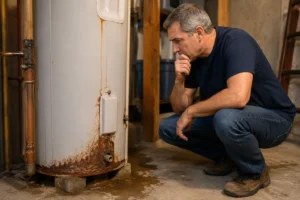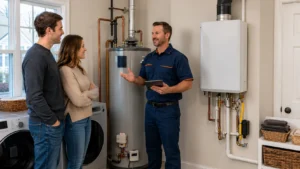
A puddle of hot water on the basement floor isn’t something you want to mess around with. If your water heater is leaking, the first few minutes matter—for safety, for damage control, and for figuring out whether this is a simple fix or if it is time to look into a water heater replacement in Woodland Park. Acting quickly can prevent structural damage to your home, and staying on top of routine upkeep can stop these issues before they start. For step-by-step guidance on keeping your system running safely, you can consult the U.S. Department of Energy water heater maintenance guide.
If you do find a leak, the team at M&S Technician is ready to help. Our experienced plumbers will locate the source of the leak, whether it’s a faulty pressure relief valve, a worn-out heating element, or a cracked tank. We provide honest, upfront diagnostics and comprehensive water heater install and repair services to get your hot water restored quickly and safely.
First 5 Minutes: Shut Things Off
Before anything else, two things need to happen.
Shut off the water supply. There’s a cold-water valve on top of the tank, usually a lever or a handle. Turn it off. If you can’t find it or it won’t budge, shut off the main water valve to the house.
Shut off the power or gas. For an electric water heater, flip the breaker labeled “water heater” at your electrical panel. For a gas water heater, turn the gas control valve to the “off” position. This is usually a dial on the front of the tank with three settings: on, off, and pilot. Set it to off.
Now you’ve stopped the leak from getting worse and prevented the heater from trying to heat an empty (or partially empty) tank, which can damage components.
Where Is the Leak Coming From?
This matters. A leak from the top of the tank is usually fixable. A leak from the bottom of the tank usually isn’t.
Top of the tank. Likely a loose cold-water inlet, a bad hot-water outlet fitting, or a failed T&P (temperature and pressure) valve. These are repairable, often without replacing the tank.
Side of the tank, near the top. Usually the T&P valve discharge pipe. The valve is doing its job, it’s relieving pressure or temperature. The question is why pressure is too high. Could be a failed expansion tank, a closed-system pressure issue, or the valve itself is bad.
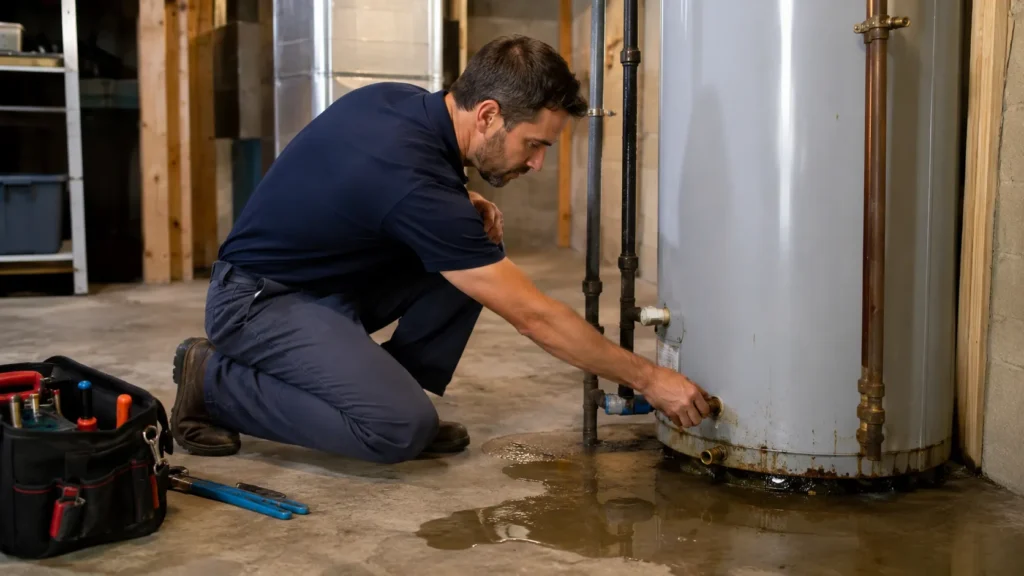
Side of the tank, near the bottom. Often the drain valve. These can leak after a flush or just from age. Sometimes a quick tightening fixes it. Sometimes the valve has to be replaced.
Bottom of the tank, water pooling underneath. This is the bad one. It usually means the inner tank has corroded through. Water heaters aren’t repairable when the tank itself fails. Replacement is the only fix.
Around fittings. Loose connections from age, vibration, or a previous repair. Often a tightening or a fresh wrap of thread sealant fixes it.
The Five Most Common Causes
T&P valve discharge. The valve relieves excess pressure or temperature. If it’s discharging, that’s a feature, not a failure, but the pressure issue underneath needs to be addressed. Common cause: a failed expansion tank.
Tank corrosion. Over years, sediment builds up at the bottom of the tank. The anode rod corrodes away, then the inner steel tank starts corroding. Once you see water from the bottom, the tank is done.
Loose drain valve. At the bottom of the tank. Used for flushing. These can fail or just loosen over time. Sometimes fixable, sometimes not.
Condensation (not actually a leak). A cold-water inlet running through warm air can produce condensation. Look for water that appears mostly during high-use periods. If it dries out between uses, it’s probably condensation, not a leak.
Failed cold-water inlet or hot-water outlet. Fittings at the top of the tank can fail. Repairable.
Is This an Emergency?
Quick decision tree:
- Active flooding, water pouring out → emergency, shut off everything and call us
- Steady drip from the bottom of the tank → urgent, tank is failing, plan for replacement this week
- Slow drip from a fitting at the top → not an emergency, schedule a repair in the next day or two
- Periodic discharge from the T&P valve → not an immediate emergency, but the underlying pressure issue needs a tech
If hot water is on the floor and there’s an electrical outlet or appliance nearby, that’s an electrical hazard. Get out, kill the breaker if it’s safe to do so, and call.
Repair vs. Replace
Quick rules of thumb:
- Tank under 8 years old, leak from a fitting → repair
- Tank under 8 years old, leak from the bottom → tank may still be salvageable; have it diagnosed
- Tank 8–12 years old, leak from a fitting → repair if simple
- Tank 8–12 years old, leak from the bottom → replace
- Tank 12+ years old, any kind of leak from the tank itself → replace
Most residential tank water heaters last 8 to 12 years. Pushing past 12 is rare in our area because the water has enough mineral content to corrode the tank from the inside.
Why Hard Water in Passaic County Matters
Passaic County water has moderate mineral content. That sediment builds up at the bottom of the tank over time and accelerates corrosion. Annual flushing slows it down a lot, but most homeowners never flush their water heaters. By year 10, sediment can be inches deep, and the tank starts failing soon after.
If you’ve never flushed yours and the tank is over 8 years old, that’s worth knowing as you make the repair-vs-replace call.
Preventing the Next Leak
If we just finished a repair on your water heater, here’s what extends the life of the unit.
Annual flushing. Sediment is the #1 enemy of a tank water heater. A yearly flush takes about 30 to 45 minutes, and it dramatically slows down the corrosion that eventually causes leaks.
Anode rod check. The anode rod is a sacrificial metal rod inside the tank that corrodes instead of the tank itself. Once it’s fully consumed (typically 4 to 6 years in our area), the tank starts corroding. Replacing the anode rod when it’s worn down extends tank life significantly.
Pressure monitoring. A failing T&P valve or a broken expansion tank can let pressure climb high enough to damage the tank. If the T&P valve is discharging periodically, that’s a warning sign, the underlying pressure issue needs to be addressed.
Watch for early signs. Rusty hot water, rumbling sounds, or any moisture around the base, those are early warnings. Getting them checked now is much cheaper than dealing with an emergency leak later.
The honest truth is that all tank water heaters eventually fail. But proper maintenance can mean failure at year 14 instead of year 9, and a controlled replacement instead of a flooded basement.
Frequently Asked Questions
Do you offer same-day water heater service in Woodland Park?
Yes. We schedule same-day water heater service Monday through Saturday whenever our route allows. For active leaks or no hot water, we can usually get someone out within a few hours. Call (908) 528-0535.
Do you serve all Woodland Park neighborhoods?
Yes. We’re based in Woodland Park, so every neighborhood is within minutes. We also cover surrounding towns including Little Falls, Totowa, Clifton, and Wayne.
Do you work on tankless and traditional tank water heaters?
Yes. We service both tank and tankless water heaters, gas and electric. If you’re thinking about switching from tank to tankless during a replacement, we can walk you through whether your home setup makes that practical.
Do you offer financing on water heater replacement?
Yes. We offer financing on new water heater installations to help spread out the cost. Ask about current plans when you call.
Are you licensed and insured in New Jersey?
Yes. M&S Technician holds NJ HVAC License #368100867400 and carries full liability insurance. We’ve been a licensed contractor in North Jersey since 2014.
Need a Tech Today?
If your water heater is leaking and you’re not sure what to do next, call M&S Technician at (908) 528-0535. Same-day water heater service across Woodland Park and Passaic County.
M&S Technician. Licensed HVAC contractor in Woodland Park, NJ. Same-day water heater service across Passaic County.
Phone: (908) 528-0535 (click-to-call on mobile) Address: 4 Winslow Place, Woodland Park, NJ 07424 Hours: Mon–Sat 9:00 AM – 8:00 PM NJ HVAC License #368100867400