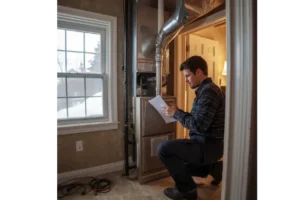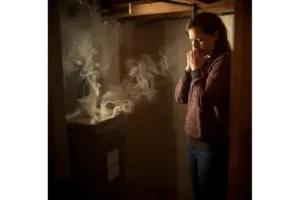
Your furnace is talking to you. The question is, are you listening?
Most homeowners in Woodland Park and Bergen County ignore their heating system until it stops working completely. But your furnace gives you plenty of warning before it fails, you just need to know what to listen for. Those strange furnace noises aren’t just annoying background noise during your favorite TV show. They’re your heating system’s way of crying for help.
After years of responding to emergency heating calls at M&S Technician, we’ve learned something interesting: nearly every catastrophic furnace failure we see was preceded by weeks or even months of unusual sounds. Homeowners heard the noises, shrugged them off, and then faced expensive emergency repairs when the system finally quit.
Today, we’re breaking down the five most common furnace noises, what’s causing them, and more importantly, what happens if you ignore them. Think of this as learning your furnace’s language before it goes completely silent.
1. The Loud Bang or Boom When Your Furnace Starts
What it sounds like: A single loud boom or bang right when your furnace kicks on, like someone dropped a heavy textbook inside your ductwork.
What’s actually happening: This is called delayed ignition, and it’s one of the most serious sounds your furnace can make. Here’s what’s going on inside your system: gas is flowing into the combustion chamber, but it’s not igniting immediately. Gas builds up for a few seconds, and when ignition finally happens, all that accumulated gas ignites at once. That’s your boom.
The most common culprit is a dirty burner. Over time, dust, debris, and carbon buildup coat your burners and prevent proper gas flow and ignition. The flame sensor might also be covered in residue, causing it to fail at detecting the flame and delaying the ignition sequence.
Why you can’t ignore this: That small explosion is happening inside your furnace every single time it cycles on. Each bang is stressing the heat exchanger, which is the most expensive component in your furnace. A cracked heat exchanger means carbon monoxide can leak into your home, and it typically means you need a complete furnace replacement rather than a simple repair.
Delayed ignition also wastes gas during those few seconds before ignition. More seriously, if the buildup of unignited gas is significant enough, the boom could actually crack your heat exchanger in a single event.
If your furnace is making this sound, call M&S Technician immediately at (908) 528-0535. This isn’t a “wait and see” situation. We need to clean those burners and inspect your heat exchanger before you have a dangerous carbon monoxide situation.
2. High-Pitched Whistling or Screaming
What it sounds like: A tea kettle whistle or high-pitched scream that might start and stop or continue while the furnace runs.
What’s actually happening: This piercing sound usually indicates restricted airflow somewhere in your system. Think about what happens when you partially cover the end of a vacuum hose, it makes that high-pitched whine. Your furnace is doing the same thing.
The most common cause is a severely clogged air filter. When airflow is restricted, air gets forced through tiny gaps at high velocity, creating that whistling sound. But it could also be closed or blocked return vents, ductwork that’s too small for your system, or a blower wheel that’s caked with debris.
A belt-driven blower system can also create this sound when the belt becomes worn, misaligned, or glazed. As the belt slips against the pulleys, it produces a high-pitched squeal that’s unmistakable.
Why you can’t ignore this: Restricted airflow makes your furnace work exponentially harder to heat your home. Your blower motor is running at maximum capacity trying to push air through that restriction. This dramatically shortens the lifespan of your blower motor, which is an expensive component to replace.
More immediately dangerous, restricted airflow causes your heat exchanger to overheat. When metal repeatedly heats beyond its design limits and then cools down, it develops cracks. We’re back to that carbon monoxide risk, plus the potential for complete system failure.
Start by replacing your air filter. If the whistling continues, you need professional furnace repair in Woodland Park to identify and resolve the airflow restriction before it causes permanent damage.
3. Scraping, Grinding, or Metal-on-Metal Sounds
What it sounds like: Nails on a chalkboard, metal scraping against metal, or a grinding sound like a car with bad brakes.
What’s actually happening: Something inside your furnace is physically touching something it shouldn’t be touching, and metal is grinding against metal. In most cases, this is your blower wheel.
Your blower wheel is the fan that actually moves air through your system. It’s mounted on a shaft with bearings that allow it to spin freely. When those bearings wear out, the wheel can shift position and scrape against the blower housing. Sometimes the blower wheel mount loosens and the entire assembly drops slightly, causing the same scraping sound.
Less commonly, you might have a cracked or broken blower wheel, with pieces of metal flapping around and hitting other components. This can happen if the wheel becomes unbalanced, corrodes, or if something got sucked into the blower assembly.
Why you can’t ignore this: Every second that metal-on-metal contact continues, you’re creating metal shavings and debris inside your furnace. Those particles get blown throughout your ductwork and into your living spaces. More importantly, that grinding is destroying components and creating shrapnel that can damage other parts of your system.
A damaged blower wheel that comes apart while spinning at high speed can destroy your entire blower assembly, puncture ductwork, and even damage your heat exchanger. What starts as a $300 blower motor repair can quickly become a $2,000+ complete blower assembly replacement if the wheel disintegrates.
Turn off your furnace immediately if you hear scraping or grinding. Don’t run it until M&S Technician inspects and repairs the blower assembly. The damage accelerates rapidly once metal-on-metal contact begins.
4. Rattling, Vibrating, or Loose Component Sounds
What it sounds like: Something loose rattling around, like someone put bolts in a jar and shook it. The rattling might be constant while the furnace runs or might start and stop.
What’s actually happening: This is usually the simplest problem on this list, but that doesn’t mean you should ignore it. Something has come loose inside your furnace or in your ductwork.
Common culprits include loose access panels, unsecured ductwork, a loose blower motor mount, worn motor mounts that no longer dampen vibration, or even loose screws rattling around inside the cabinet. Sometimes the heat exchanger itself develops cracks that cause panels to rattle as air moves through them.
In ductwork, you might have loose duct joints, unsecured registers, or flex duct that’s come partially disconnected. The vibration from your furnace running amplifies these loose connections into that annoying rattle.
Why you can’t ignore this: While a loose panel seems harmless, those vibrations indicate mounting hardware that’s failed. If motor mounts are worn, your blower motor isn’t properly supported and will fail prematurely. Loose ductwork means you’re losing heated air into spaces like crawlspaces or attics instead of heating your home, wasting energy and money.
More concerning, rattling from the heat exchanger area could indicate cracks developing in the metal. As sections of cracked metal vibrate against each other, they create that rattling sound. This circles back to our carbon monoxide concern and potential system failure.
The good news is rattling is often the easiest problem to fix. Schedule a heating system inspection with M&S Technician and we’ll track down that rattle and secure any loose components before they cause secondary damage.
5. Clicking That Continues Beyond Startup
What it sounds like: Rapid clicking sounds, like someone rapidly flicking a lighter, that either continue non-stop or start and stop in patterns.
What’s actually happening: Some clicking is normal when your furnace starts up. You should hear a few clicks as the ignition system attempts to light the burners. But if clicking continues for more than 10–15 seconds, or if you hear clicking but your furnace never actually starts, something’s wrong.
Continuous clicking usually means your ignitor is trying repeatedly to light the gas but failing. This could be a faulty ignitor that’s not creating a strong enough spark, a gas supply issue preventing gas from reaching the burners, or a failed flame sensor that’s not detecting the flame even when it lights successfully.
Sometimes the clicking comes from a failing relay switch or control board. Electrical relays make clicking sounds as they engage and disengage. If a relay is stuck or failing, you’ll hear rapid clicking as it tries unsuccessfully to complete its circuit.
Why you can’t ignore this: A furnace that’s clicking but not starting means no heat for your home, but it’s also trying to fill your combustion chamber with gas. While safety mechanisms should prevent dangerous gas buildup, a malfunctioning system with multiple failing components might not execute those safety protocols properly.
Each failed ignition attempt also puts stress on your ignitor. These components have a limited lifespan measured in ignition cycles. The more times it attempts ignition unsuccessfully, the faster it wears out. A $150 ignitor replacement can quickly become a $500+ control board replacement if the underlying electrical issue isn’t addressed.
If your furnace clicks but won’t start, don’t keep adjusting your thermostat trying to get it to work. Each time you do this, you’re commanding another ignition attempt and potentially another small amount of unignited gas in your combustion chamber. Instead, call M&S Technician for immediate furnace repair in Bergen County and let us diagnose and fix the ignition system properly.
What All These Sounds Have in Common
Notice a pattern? Every single sound we’ve discussed represents a problem that gets exponentially worse the longer you ignore it. A $200 repair today becomes a $1,500 repair next month and a $4,000 furnace replacement next year.
Your heating system is designed to operate quietly. Modern furnaces should be barely audible beyond the gentle whoosh of air moving through your vents. Any sound that makes you stop and wonder “what’s that noise?” deserves attention.
At M&S Technician, we’ve responded to countless emergency heating calls that started with homeowners saying “it’s been making that noise for a while, but I thought it was normal.” By the time they called, what could have been a simple repair had cascaded into major component failure.
The Real Cost of Ignoring Furnace Sounds
Let’s talk numbers, because that’s what really motivates action. Here’s what we typically see when furnace noises are ignored:
A dirty burner causing delayed ignition costs about $150–250 to clean and service. Ignore it until the heat exchanger cracks? You’re looking at $1,500–3,000 for heat exchanger replacement, or more likely, complete furnace replacement ranging from $3,500–6,000.
A worn blower motor bearing creating that grinding sound costs roughly $300–500 to replace. Wait until the blower wheel destroys itself and damages the housing? Now you’re paying $800–1,200 for complete blower assembly replacement.
A failing ignitor causing clicking sounds runs $150–300 to replace. Ignore it until the control board burns out from repeated failed cycles? Control boards cost $400–600, plus the ignitor you’ll still need to replace.
The pattern is clear: early intervention saves you thousands of dollars. It also saves you from being without heat during a Morris County cold snap while you wait for parts to arrive or a complete system replacement to be installed.
When to Call for Professional Furnace Repair
You should contact M&S Technician at (908) 528-0535 immediately if you hear any of these furnace noises:
- Any banging or booming sounds during startup. This is a safety issue that requires immediate attention.
- Continuous scraping or grinding metal sounds. Turn off your furnace and call before running it again.
- High-pitched screaming that continues after you’ve replaced your air filter. This indicates a serious airflow restriction.
You should schedule service within the next few days if you hear:
- Rattling or vibrating sounds that persist even after securing loose panels.
- Clicking that extends beyond startup or clicking with no ignition.
The M&S Technician Diagnostic Approach
When you call us about strange furnace noises, we don’t just address the noise itself. We investigate why that sound is happening and what other components might be affected.
Our technicians use diagnostic tools that go beyond just listening. We check static pressure to evaluate airflow, test electrical components with multimeters, inspect heat exchangers with cameras, and measure combustion efficiency to ensure your system is operating safely.
We explain exactly what we find, show you the problem components when possible, and provide clear pricing for repairs before we start work. Our goal isn’t to scare you into unnecessary repairs. It’s to help you make informed decisions about your heating system based on actual conditions, not guesswork.
Prevention: The Sounds You’ll Never Hear
The best furnace sound is one with no furnace noises at all. Regular maintenance prevents most of the issues that create these warning noises in the first place.
During an annual furnace maintenance visit, we clean burners before delayed ignition develops, lubricate bearings before they start grinding, replace worn belts before they start squealing, and tighten components before they start rattling. We also replace ignitors that show signs of wear before they fail completely.
Maintenance customers almost never experience unexpected breakdowns because we’re catching and correcting issues during routine service visits. They’re also not paying emergency service rates when problems do occur because they’ve scheduled regular appointments during normal business hours.
Your Furnace Is Trying to Tell You Something
Those strange furnace noises aren’t something you’ll eventually get used to. They’re early warning signs of problems that will get worse, more expensive, and potentially dangerous if left unaddressed.
The homeowners who save the most money and experience the fewest emergency breakdowns are the ones who respond quickly to warning signs. They understand that a $200 service call today prevents a $2,000 emergency repair tomorrow.
Don’t wait until that strange sound becomes complete silence and a cold house. Call M&S Technician today at (908) 528-0535 for expert furnace diagnosis and repair in Woodland Park and throughout Bergen County. We’ll identify exactly what your furnace is trying to tell you and fix it before a minor issue becomes a major expense.
Schedule your furnace inspection now and get peace of mind knowing your heating system is operating safely, efficiently, and quietly through the entire winter season.
For more information on furnaces and how they function, read this page from The Department of Energy.